


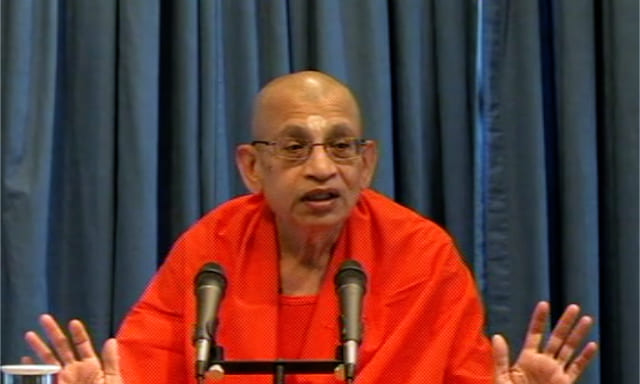
Swami Viditatmananda Saraswati
The word yoga means joining. When we study what yoga teaches us, we find that it is not a process of joining something with something else, but rather, a process of disjoining or disconnecting two entities that are as though united. We take the two entities to be one and are not able to distinguish between them. Yoga teaches that this perceived oneness of the two entities is the cause of all the pain and sorrow that we have in our lives.
Let us understand this with the help of a traditional example. When a ball of iron is heated in a furnace, it becomes red-hot and appears as a ball of fire. But this ball of fire, which is hot and round, is in fact a union or yoga of two separate entities, iron and fire. Iron is one thing and fire, something else. Each has its own properties. The ball of iron is round in shape, black in color and cold to the touch. Fire is red in color, hot to the touch and has no form or shape.
When iron and fire unite in a fireball, the qualities of each are passed onto or imposed upon the other. The ball of iron, which is black in nature and cold, becomes hot and turns red. Fire, which does not have a form of its own, seems to acquire a round shape. There appears to be a transformation in the iron taking on the properties of fire and fire in turn, taking on the shape of the ball of iron. Both entities unite to become one entity called a fireball. A person who does not know what iron is and what fire is, may take the fireball to be one entity and think that there is indeed a red-hot ball of fire. But there cannot be a ball of fire because fire does not have a form.
A misunderstanding can thus be created if we do not know that what appears to be one, is in fact a union or yoga of two. When we look at that fireball with the knowledge that it is in fact made up of two entities, a process of separation takes place in our mind. We then recognize that the round form belongs to the iron and not to the fire, and that the red color and heat belong to the fire and not the iron ball. So, while the fire appears to be round it remains formless and even while the iron appears to be red and hot, it continues to be black and cold. When this fireball cools down, the iron again becomes cold and black as before and the fire merges back into its formless nature. This separation should take place in our minds in order for us to understand what iron is and what fire is. That is what yoga explains to us.
Yoga is the traditional teaching of ancient India. What it teaches is that there is a union of two separate entities in our lives; a union of the person, puruùa, and the personality, prakçti. So what we call ‘I’ indeed involves the person and the personality. What is this person, and what is this personality? By personality, we normally mean our body, our sense organs, our mind and our intellect. Yoga explains that personality or the body-mind-sense complex, which is made of matter, is inert or insentient by nature. Our mind and sense organs are products of matter in its subtle state and our body is the product of matter in its gross state. However, we find the body to be sentient. We find that our sense organs and mind enjoy liveliness or sentience. What is it that brings about this sentience in the body-mind-sense complex? It is that which is called the person or the Self, or the Consciousness or the Awareness. Let us take the example of a glowing bulb. What causes this bulb to glow with light? We know that light is a product of the union of electricity and the filament that is inside the bulb. Mere electricity cannot produce light, and by itself, a filament cannot produce light; but the union of electricity and filament produces light. Similarly, mere personality does not have life, and mere Consciousness also is not sufficient to have life. Just as the union of electricity and filament brings about a phenomenon called light, similarly also, the union of the person and the personality, the self and the non-self or the Consciousness and the material personality, results in a phenomenon called ‘life’. We thus see how you and I already represent a union, that of the person and the personality.
Let me point out another very important thing. What is it that separates one individual from another? Is there something that is common to all of us? We see that on the surface, each one of us is different. But are we really totally different from each other or is there something that is common to us? Is there a connecting link? Yes, there is. We know that there can be different bulbs having different capacities and therefore the light given out by these bulbs varies. However, the electricity that is passing through all the bulbs is one. Thus even though each bulb has its unique potential, all of them share the same electricity. Similarly, each one of us has a unique personality. Our emotions are different, our knowledge is different, our sense organs are different, our bodies are different and our personalities are different. But the person, the Consciousness, the Self that informs all of us, is the same.
I take myself to be the body, the sense organs or the mind. My conclusion about myself is that I am confined to the personality. What yoga teaches us is that we are not merely this personality; that we are not merely the body; that we are not merely the sense organs and that we are not merely the mind. The personality is, in fact, the vehicle for the manifestation of the person. Just as electricity is a subtle principle and requires a filament, a bulb and such other appliances to become manifest, similarly, Consciousness or the Self requires this personality to become manifest as life.
Is there a problem in taking myself to be the personality? My conclusion or judgment that I am my personality plays a very important role in my life. Equating myself to my personality creates in me a sense of smallness and a sense of confinement. When I look at the whole world around me, I find myself to be nothing, I feel insignificant. In 1969, when man first landed on the moon, the television anchors were showing us the pictures of the earth taken from the moon. The earth looked like a small globe. What is this globe? It is a small little planet in the solar system. What is the solar system? It is one little thing in this galaxy. What is this galaxy? One among countless galaxies. Therefore, who am I? I am just an insignificant little speck of dust among these countless galaxies! Thus when we look at the scope of the whole universe and look at ourselves, we find ourselves to be insignificant. Each one of us suffers from a sense of insignificance. If we were quite happy being insignificant, we would not have any problem in life. But none of us can accept that we are insignificant, that we do not count.
We cannot accept certain things about our life. Do we accept the fact that we are going to die some day? A vast majority of us do not! We always want to push death as far out as we can. Ask anyone, “Are you ready to die?” He would want “One more day”. Even a person who is dying does not want to give up. A grandmother wants to see her grandson married; she is waiting for a great-grandchild! They still have a lot of aspirations or things to do. Nobody is willing to die. We cannot accept death; we cannot accept old age; we cannot accept gray hair, and we cannot accept wrinkles on our faces. We do not like to see that we are growing old and we do not like the idea that someday we may die. Even though we know that whosoever is born has to die, we still cannot accept this reality of life.
Similarly, we cannot accept ignorance. Nobody likes to be called ignorant or stupid or foolish, even though the world may judge him to be so! A new patient, who had been admitted to a lunatic asylum, was telling another patient all about himself. A doctor came to the new patient and asked him, “Hey, what is your name?” The new patient did not reply. “Where do you come from?” No reply. “What is the problem?” No reply. For about 10 minutes, the doctor tried to elicit information from this patient, but he would not oblige at all. In frustration, the doctor left. After the doctor had left, the other patient asked the new one, “You have been telling me all about yourself. Why did you not answer the doctor? The patient answered, “Do you think I am a fool? The doctor has my file and all the information he wanted is right there!” Thus even a foolish person does not want to accept that he is a fool. Even though we know that we are ignorant, we do not accept our ignorance.
In the same way, we cannot be happy in being unhappy. We cannot accept unhappiness or sorrow, being ignorant or being mortal. In fact, our life is a process of constantly trying to get rid of these things; we are always trying to learn new things. The information industry as in the television, magazines, newspapers, radio and the internet, survives because of the curiosity in us. We want to know what is happening. Pursuing knowledge is one of the most important activities in our life. Another very important activity is to try and push death as far away as we can. The healthcare industry survives because of our innate desire to avoid death. The entertainment industry survives because of our innate desire to be happy. We are constantly trying to search for happiness, search for knowledge and search for immortality. If I ask you how much happiness you want, you will tell me you want all the happiness. If I ask you how long you want to be happy in a day, you will tell me that you want to be happy 24 hours a day. If I had my way, I would not want a moment of unhappiness. I want to be happy everywhere, at all times, at all places and under all conditions.
Thus our life is a process of searching for or seeking these three things:
knowledge, immortality and happiness. If you analyze all the activities that we do, you will find that everything that we do is prompted by one of these three things. We are trying to become happier than we are, or trying to avoid death, and live as long as we can, or trying to pursue knowledge. Why do I want to become free from mortality? It is because I have concluded that I am subject to death. Why do I pursue knowledge? It is because I have concluded that I am ignorant. Why do I pursue happiness? Again because I have concluded that I am unhappy. So my pursuit of knowledge, my pursuit of happiness and my pursuit of immortality arises from a conclusion about me that I am, by nature, ignorant, unhappy and mortal. This is my conclusion about myself.
But is it the reality about myself? Am I really mortal, unhappy and ignorant by nature? No. Then why do I take myself to be so? This conclusion arises from the confusion of taking one thing to be the other. As we saw earlier, the ‘I’ is the union of both, person and personality. The personality is a vehicle for the manifestation of the person. The true nature of the ‘I’ is the person, the Consciousness, or the Self. However, I equate myself with the body and take myself to be a mortal being; I equate myself with the mind and take myself to be a limited being, and I equate myself with the intellect and take myself to be an ignorant being. This is how the yoga or the union began. We habitually equate ourselves with the personality and thus entertain notions about ourselves being mortal, unhappy and ignorant and suffer on account of these notions. All the pain and suffering in our lives is on account of our not being able to separate the two entities of person and personality, and can be traced to these erroneous conclusions. We are trying to solve the three problems of death, unhappiness and ignorance all the time, but these are not legitimate problems because the truth or reality about I is not what I imagine it to be, but something else.
The purpose of yoga is to recognize this reality, or my true nature. The ‘I’, the person, is by nature immortal, all knowledge or consciousness and all happiness or fullness. All the wholeness or completeness and happiness is within me, the consciousness is within me, and the immortality is within me. When we understand this, we have to live a life in a manner that this truth about ourselves becomes a reality for us. Therefore, yoga teaches us a way of life by which this truth can progressively become a reality. Yoga is defined in the scriptures as being that state in which we become completely free from all the disturbing thoughts and there is abidance in our own nature. The entire science and practice of yoga is prescribed to bring this about.
The fact is that I already am what I am trying to become. I am seeking something in life outside of myself, while in fact, what I am seeking is the ‘I’, my own self. We tell the famous story of The Ten Boys to illustrate this. Once upon a time, ten young boys from a village decided to go on a picnic. They went to their parents to seek permission. Their parents told them, “There are ten of you. Make sure that all of you return safely.” Of the ten boys, one was taller and heftier than the rest. He was appointed leader and assigned the responsibility of making sure that all of them arrived back safely. The boys set off and after a while they came across a river. All the boys knew swimming and therefore plunged into the river, swam across and reached the other bank. The leader said, “Let me verify if all of us have reached safely”. He asked his friends to line up so that he could count everybody. He began to count, “One, two, three, four, five, six, seven, eight, and nine. We were ten when we left, but now we are only nine!” He counted again, from the other end of the line. “One, two, three, four, five, six, seven, eight, nine. What happened to the tenth boy?” He counted several times, and every time the count went up to nine only. He invited one of his friends to count. But his friend had studied in the same school! His count also was nine! One by one each of them came forward and counted. And each of them came to the same conclusion that there were only nine of them and not ten! They concluded that the tenth boy was lost and became very worried. They divided themselves into different search parties. One search party went into the water to see if the lost boy had drowned. The other search party started searching on the banks of the river. The interesting thing is that nobody had a description of the tenth boy and neither did they even think about it. All they thought was that they had to search for missing the tenth boy. They searched for the tenth boy for the rest of the day, but could not find him. In the evening all of them gathered again, disappointed. Not knowing what to do, they began to cry. At that time, an old man happened to pass by. He asked what the matter was, and the leader got up and recounted the whole story of how they had lost the tenth boy. “How did you determine that one of you is lost?” “I counted them”. “Show me how you counted them.” “Ok. Let me show you.” He asked his friends to line up and he counted. “One, two, three, four, five, six, seven, eight, nine.” The old gentleman realized what the matter was. He said, “Do not worry my children. The tenth boy is here.” “Oh really, please tell us where he is!” The boys thought that the man may have seen this tenth boy somewhere. “Where is he?” “Do as I tell you.” He asked them to line up to be counted. “Now again count carefully,” he said. The leader again started counting hopefully. “One, two, three, four, five, six, seven, eight, nine.” Puzzled, he looked at the old man and asked, “Where is the tenth boy?” The old man said, “You are the tenth boy”. “What?” Then he understood, “Hey! I am the tenth boy.”
When I tell children this story I ask them how many ‘tenth boys’ there are. “One.” “Which one?” “The one who counts.” But each one counts by turn. And each one of them is, in turn, the tenth boy. So in the story, when each boy counted and searched for the tenth boy, he was really searching for himself. Isn’t it amazing that they were searching for themselves? When can this happen? When it is concluded that the tenth boy is lost, when he does not know who he is and when he takes it for granted that he is not the tenth boy because his mind is distracted away from himself. So to find the tenth boy what should he do? He should turn his mind away from looking outside and look at himself. This is what we do not have an opportunity to do. We always look outside of ourselves to solve every problem. When I am sad or unhappy, I look for and find the cause there, outside.
“Why are you sad this morning?” “My parents are not listening to me.
Therefore, I am sad.”
“Why are you sad?” “I received a letter from my parents this morning!” “Why are you sad?” “I do not have a job”.
“Why are you sad?” “I have a job”.
“Why are you sad?” “I am not married”.
“Why are you sad?” “I am married”.
“Why are you sad?” “I do not have children”. “Why are you sad?” “I have children”.
Thus, we invariably look outside of ourselves and are quite convinced that the cause of our sadness or unhappiness lies somewhere out there. Therefore, when we want to be happy, because we have concluded that happiness also lies outside of ourselves, we look for an external source. We look for wealth, name, fame, prosperity etc. for happiness. We need someone else or something else to make us happy. Our conclusion is that we are unhappy and therefore each one of us is counting for this elusive tenth man.
It has to be just the right kind of job, the right kind of house, the right kind of furniture, carpet, air-conditioning, heating, car and garage, and I am still counting! I feel that I still lack something. Everything is just as it should be and yet, the sense of something lacking does not seem to go away. I never look at myself! But this is what yoga wants us to do. We have just to look at ourselves. When can we look at ourselves? When we become free of our pre-occupation with looking outside all the time. This becoming free from our pre-occupation is a process, and yoga teaches us how to slowly achieve that. It does not mean that we become free from work or free from life. It is just our becoming free from searching elsewhere. It is one thing to lead our lives from day to day, but quite another thing to make life a process of seeking happiness and security. Right now our life has become a process of acquiring happiness and security and yoga teaches that acquiring happiness and security need not be the sole purpose of life.
When can I enjoy my life? When I do not make life a process of seeking happiness or seeking security. I erroneously conclude that I am unhappy and that my happiness has its source outside and therefore every action I perform is a means of acquiring this happiness. That is how my mind is pre-occupied with things other than myself. Yoga says that rather than that, make your life a process of giving happiness and giving security. Right now I want the world to love me. Yoga says, make your actions a means of giving love instead. Love is something to be given, not acquired. Can we find an object called love? Is there a person called love? Is there a situation called love or happiness? Love is not something that can be acquired.
The goal is to slowly become free from our constant pre-occupation with things other than ourselves, and gradually turn our mind towards ourselves, so that we may recognize what we truly are. For this, the mind should be free from the constant searching for something on the outside all the time. If I am driving at 80 miles an hour and all of a sudden realize that I am going in the wrong direction, what should I do? I cannot turn around immediately. I must first apply the brake and slow down. Only then can I slowly make a turn. Similarly, let our lives become a process of slowly becoming centered upon ourselves rather than being centered upon something external. I don’t mean becoming self-centered in the narrow sense. Let us become other-centered with reference to our activity so that our minds become centered upon ourselves.
Our lives have to transform and that transformation is what yoga teaches us. May life become a process, not of acquiring what we do not have, but a process of offering what we have. You will be surprised at all that you have that can be offered. Only when we start giving do we discover what we have. So yoga is teaching us how to make life a process of offering. That is the first step. This will then lead us to discover who we truly are and discover what we are truly searching for.
**************************
We have seen how the reality of the Self is quite different from what we take ourselves to be. We are like the boy in the story of The Ten Boys, where the one who is searching for the 10th boy is the 10th boy himself. We are searching for happiness, immortality, knowledge and intelligence outside of ourselves, while all this is our very nature. It may sound unbelievable that the one who takes him to be mortal is, in fact, immortal. What do we love in life? We love immortality, intelligence and happiness. The general rule is that there is always love for one’s own nature. Therefore, whenever I find myself ignorant or unhappy and am faced with being mortal, I become uncomfortable with myself and want to get rid of that feeling. It is like a particle of dust in my eyes, or a little bug entering my ear, that I want to get rid of. This discomfort with unhappiness etc. also shows that it cannot be my nature. Had mortality been my nature, I would be comfortable with it. For instance, I am comfortable with the fact that I can see, and when I cannot see properly, I am uncomfortable. I am comfortable with the fact that I can hear and when I cannot hear properly, I am uncomfortable. I am comfortable being healthy, because that is my nature and if I am not, I become uncomfortable. Thus by analyzing situations that make us uncomfortable, we realize that we become uncomfortable whenever we are somehow dissociated from our own nature.
That we are comfortable with our own nature shows that immortality, happiness and intelligence is our nature. Therefore, let our lives become a process of owning up to the nature of our selves; let our lives be based on the reality of our selves. Various desires arise in my mind. These are desires for happiness, mortality and I go around fulfilling these desires. But then, every attempt to fulfill a desire is a denial of me. This is like the attempt to search for the 10th boy being a denial of the 10th boy, because his very attempt to search is based on the conclusion that he is not the 10th boy. It is only when he stops searching for the 10th boy that his mind is poised to see something, to discover something. He then discovers the fact that he himself is the 10th boy that he is searching for. So also, the orientation of our mind needs a shift from being involved in this constant searching.
When the mind shifts its focus, it is poised to see the reality of the self. I can then see that I am indeed what I am searching for. How do we slowly bring about this transformation in the disposition of the mind? So far, I have been living a life which is directed outwards and it has become a habit to search for happiness outside of myself. Every desire that arises in my mind is generally based on seeking happiness or security outside of myself and as long as I keep on fulfilling that desire I continue to deny the happiness that is me. Right now, my life seems to be a denial of myself. That is why there is so much frustration in my life because these desires cannot be fulfilled. Just as the 10th boy can never be found because he is not away from himself, so also, a lasting happiness cannot be found anywhere else in life because it is not anywhere. So let this process of searching be reversed. Because I am what I seek, let me look at myself. For this, the first step would be to create a disposition of mind which is conducive to discovering or knowing the true nature of myself. Rather than seeking to acquire, let my mind be engaged in the process of offering instead; offering happiness, love and goodness.
Yoga is an eight-step process, the first two being very important. Let us discuss those first two steps now. While yoga is generally associated with yogāsanas or various body postures, and prāõāyāma or breath control, these are only the third and fourth steps in the process of yoga. The first two steps, which are rarely talked about, are yama and niyama. These are prescriptive do’s and don’ts, so that I may stop doing things that hurt me and do things that will help me instead. This self-centeredness that we are talking about, is not selfishness. It is not an exclusion of others, because it involves a practice of not hurting, and endorses the process of actively helping. When I stop hurting myself, I stop hurting others as well, and when I start helping myself, I start helping others also. The first step then, is to stop hurting myself.
Yama
We have certain negative propensities in us, and the first one is anger. Whenever we act out of anger, our action is violent. We hurt the person who becomes the object of our anger. In the process, we hurt ourselves also. Our second inclination is dishonesty.
There is a tendency to be untruthful or dishonest. When I bend the truth or violate the truth, I violate the right of somebody else and in the process, I violate myself. The third inclination is stealing. There is a tendency we have, to take things that really do not belong to us. The fourth is indulgence, a tendency to indulge in pleasures. The fifth is possession. We are inclined to possess or hoard things, and to have much more than we require. These five tendencies are well recognized. Each of us is born with these propensities.
Anger arises out of intolerance. Dishonesty arises out of insecurity. I am afraid and therefore I violate the truth to hide some limitation in myself. Stealing arises out of a sense of deficiency. Somebody else has more than me and I find that I do not have the resources to achieve what I want to achieve. Therefore, I take recourse to shortcuts to achieve at any cost, even by means that are not fair. I indulge in pleasure because my mind wants more and more pleasure. The desire to amass arises because I feel so insecure that I surround myself with material possessions to feel a sense of security. Yoga teaches us how to become free from these five propensities, one by one.
Nonviolence
The first principle that we are taught is the principle of nonviolence. Do not violate others, for the simple reason that you do not want to be violated. Nobody wants to be violated; nobody wants to be hurt. Each one of us is born with an intrinsic understanding of what we want, and know that others also want the same thing. Everyone has the love for life and for their well-being. That I want to live and live happily is the knowledge that I have about myself. And it is, that nobody wants to be hurt; nobody wants to be violated, nobody wants to be cheated and nobody wants anyone to trample upon their rights. I want to live and I want to live happily, and I do not want anybody else to come in the way of my pursuit of happiness and freedom. I also know that others want the same for themselves. They do not want me to come in their way of pursuit of their happiness and freedom either.
We are all, without exception, born with the knowledge that nobody wants to be hurt. The basic principle of nonviolence, is being aware of this and respecting other people, respecting their right to freedom, respecting their right to pursue freedom, and respecting their right to live and be happy. This is what is meant by not doing unto others what you do not want done to you. So at the physical level, I must refrain from hurting other creatures, I must conduct myself with alertness and sensitivity with respect to the feelings of other people, and I must conduct myself in such a manner that by my physical action, I do not hurt or violate other human beings or other creatures.
Speech that is pleasant and not hurtful, is another aspect of nonviolence. I can also hurt others by my speech. Very often, I utter sentences which hurt the feelings of other people. Therefore, may I be careful not to hurt the sentiments of others, and strive to speak that which is pleasant and not hurtful.
Yet another aspect of nonviolence, is at the level of the mind. Thus may I refrain even from entertaining unkind thoughts! We hurt others when we are overcome by anger. When I act out of anger, my action becomes hurtful, when I speak out of anger, my words become hurtful and when my thoughts arise out of anger, my thoughts also become hurtful to others. Sometimes the mind wonders how fitting it would be if something unfortunate happens to someone that we dislike. In my school days, I was supposed to be a bright student, and up to the 7th grade, was always ranked first in school. However, when I went to the 8th grade, a new student joined my class from another town, and he was brighter than me. From then on, I would get only the 2nd rank and not the first. So at the time of the examinations, I would think how nice it would be if this other fellow met with an accident, or broke his hands or legs, so that he could not take the exam. Why? So that I would retain my first rank! I was angry at that person. I could not accept the fact that I was not ranked first and started entertaining unkind thoughts about that person. Thus, when I think or speak or act out of anger, my actions are hurtful to others.
It is a universal principle that no creature wants to be violated. Somebody asked me whether these values are relative. They are not relative. Each one of us has a value for nonviolence. We know that even a violent person himself, does not want to be violated. When somebody commits a crime, he tries his best not to be caught. Why?
Because he does not want to be hurt.
If every human being values nonviolence, why is there so much violence in the world? Why do I myself violate this value? The answer is: whenever I act out of anger or jealousy or such passions, I commit violence. Therefore, in order for me to be nonviolent, I have to look at my anger, understand its cause and deal with it. Anger does not go away simply because we want it to go away. You cannot give it up, like you can give up smoking. If you are provoked, you will get angry.
Pujya Swami Dayanandaji invites people to do this exercise about anger. “I invite you to get angry. Come on, become angry”, he says. Understand that we do not decide to become angry. We do not have freedom when anger comes; we become helpless. Therefore, all violence that happens, is out of helplessness and not out of will. When I feel accepted or feel loved, I am kind, not violent. I get angry only when I feel hurt, rejected or insulted. Anger is a sign, not of strength, but of weakness. Therefore, I should have a value for becoming free from anger. Then alone I can become non-violent, and then alone I can possess the mind and enjoy composure. Otherwise the mind becomes disturbed.
What is the cause of anger? Is it outside of myself or is it within myself? The cause of anger is within me. Others only push my buttons. When I flick the light switch on or the fan switch on, the light has no choice but to light up and the fan has to begin to rotate. Similarly, I have a button called anger, a button called jealousy, a button called resentment, and so on. When somebody pushes my anger button I have no choice but to become angry. I have no freedom at all. Therefore, I have to work on it. That is why anger is compared to fire; the more I appease that anger, the more intense it becomes.
What do I do? Let me become an accepting person. Anger comes because I am not tolerant. I cannot accept other people as they are. I want them to be different. I have a prescription for everybody’s behavior, my spouse’s, the children’s and even the neighbor’s. Rather than prescribing how others should be, let me accept them for as they are. Because they are created this way. Let me accept the creator for creating them this way and not demand that everybody should be agreeable to me, not demand that everybody should respect me and not demand that everybody else should love me. Let everybody have the freedom to be what they are.
The way to deal with anger, therefore, is to accept that the world is not in my control; the world has its own agenda. Everyone has his own mind, his own personality, and his own agenda and therefore, let me accept them for what they are as best as I can. Let me also enjoy the freedom to be what I am, accepting things as they are, as best as I can. It does not matter how the person is. Accept the person, even if he is hurting or insulting. His behavior is his problem. He must be himself suffering from some hurt or guilt, and perhaps that is manifesting as this behavior. Thus, anger can be dealt with by forgiveness. Can I become larger than I now am to forgive and accommodate that person? Can I be more compassionate and large-hearted than I now am? I cannot expect to remain as I am and hope to become free from anger. Anger draws attention to the fact that I am not large enough, that I am not accommodating enough.
Whenever anger arises in me, it tells me that I am not kind enough or accepting enough. Let us use every occasion of anger to learn something. Let us not get angry at anger. Let me be kind to myself also. Just as any pain that arises in our body draws our attention to something that needs to be done, when anger arises in my mind, it draws my attention towards something that needs to be done. It challenges me or demands that I should become more large-hearted. Let me take on that challenge and try to win. It does not happen right away; it is a process. If you have a value for becoming free from anger, in course of time, anger will go away. We will be able to accomplish this by growing in maturity and becoming larger than we now are. In this manner I grow to be nonviolent.
Truthfulness
The second principle to follow, is truthfulness or becoming free from dishonesty. It is out of our own inner insecurities that we violate the truth. Therefore, we have to make a commitment to truth, that whatever I speak, may it be true. I don’t have to always speak what is truthful, but when I do choose to speak, I will speak only the truth. People say that the truth is always bitter. Very often, in the process of speaking the truth we end up hurting other people. So when you speak, try to speak in a manner that is pleasant.
Non-stealing
The third principle to abide by, is non-stealing. In a civilized society, we do not steal and therefore we generally do not have to worry about this value. However, there is a subtler level of stealing which takes place sometimes. We don’t steal by shop-lifting etc. But sometimes we do not fulfill our own responsibilities. Let us say that I am employed in a place to work for so many hours, at a certain salary. Sometimes we steal time from our work and are not quite honest about our duties and responsibilities. That can be equated to stealing. Therefore, non-stealing calls for being a responsible person.
Non-indulgence
The fourth principle to practice, is non-indulgence. Life is meant for enjoyment, but sometimes in the process of enjoyment, we lose ourselves. We become controlled by the objects of pleasure. Let me retain my control and freedom whenever I am enjoying things. There is a statement which says, ‘May you eat food; let food not eat you. May you drink something, let not that drink you.’ Sometimes when I am at a dining table and the food is delicious, food starts eating me. I know what my stomach can handle, but sometimes I lose control. I go in for a second helping, a third helping, a fourth helping and so on. In the process I become controlled by food.
We also get addicted to pleasure. Everything is there to be enjoyed, but the enjoyment becomes a blessing only if we can retain our freedom and not lose it in the process of enjoyment. For many years I never drank tea. When I started working in a factory, I saw that many others were sitting and enjoying drinking tea. To be with them, I also started drinking tea — one cup in the morning, one cup in the afternoon, and one cup whenever somebody visited me, and so on. Soon I was drinking 5 to 6 cups of tea a day. One morning when I did not get my cup of tea at the usual time, I found that I had a severe headache. I had a stomach upset and threw up. I realized that I had become addicted to tea. No more was I drinking the tea; it was drinking me! Similarly, when I start smoking, the cigarette soon starts smoking me. When I cannot do without something, it means that I am controlled by it; that I have lost my freedom to it. So when we enjoy the object, let us retain our freedom and our control by not getting addicted to the object. I do what is conducive to my well-being, in moderation, and in keeping with a certain discipline. I thus maintain my freedom. This is freedom from indulgence.
Non-hoarding
Finally, we have to work for freedom from possessing or hoarding. People are in the habit of acquiring things, clothes, shoes, hats etc. Someone even has 36 pairs of shoes! Nature has given us resources, but the resources are limited and they are meant for all creatures, not just for me. Therefore, I may take only what I require, and must leave the rest for others. Animals take only what they require and leave the rest of the resources for other creatures. They do not have a freezer to stock their food! They don’t have closets or warehouses either! They have trust in the scheme of things and therefore, take only what they need. We don’t have that trust and wind up collecting and storing lots of things. In the process, we deprive others who may be needier than we are. My eating more food than I require, may deprive others who may be needier. Consuming anything more than I require is depriving others who may need it. This requires us to be alert and conscious about our consumption. We are a consumer society and there seems to be a value for consuming more and more. But there are people in this world who are needier than us. Taking from nature only what we need and no more, is a discipline to be cultivated.
We have to make the effort to espouse these principles. The first principle is nonviolence, the second is truthfulness, the third is non-stealing, the fourth is nonindulgence, and the fifth principle is non-hoarding or non-stocking. Because we have the propensity to go against these values, we have to deliberately begin to deal with them.
Niyama
Yama is giving up the five negative propensities of violence, falsehood, etc. Niyama is the five virtues that we should acquire. The first is purity or cleanliness, the second is contentment, the third is austerity, the fourth is worship and the fifth, is a life of service.
Cleanliness
Cleanliness is being clean on the outside as well as within. With reference to inner purity, let my intentions be pure, let them be as honest as possible. We do so many things formally, whether we mean them or not, like the smile we offer to strangers, or words like ‘Dear friend’ while writing a note or letter. There are many things that we say and do, which we may not even mean. Like saying, ‘I love you’, whether or not we do. The idea is that the thoughts we entertain in the mind are quite different from what we let somebody see. There is a disparity between the two. Therefore, let there be cleanliness or purity. Let my thoughts be true to my word, and let my words be true to my thoughts. Let my intentions be clear, let my intentions be honest and let my intentions be kind. This is purity within.
Contentment
Contentment is a virtue. Let us be content or happy with what we have. Very often I am a dissatisfied person, always complaining about things that I don’t have. It looks like my mind seems to always be centered on what I do not have. Therefore, very often, I do not value what I do have. A poor man once went to a saint, and asked for help.
The saint asked, “Do you have nothing with you?” “No.”
“I see that you have two eyes. Can you give me one eye? I will give you a million dollars for it.” “I can’t do that.”
“You have two ears. If you give me one of them, I will give you half a million dollars for it.” “No, I can’t do that.”
“You have two arms. Can you give me one? I will give you two million dollars in exchange.” “I can’t do that.”
“You have two legs. Can you give me one for three million dollars?” “No.”
“Look, you already have thirteen million dollars with you.”
This story illustrates how we do not value what we may have, when we conclude that we do not have something or the other.
Yoga asks us to appreciate what we have. Count your blessings and be appreciative and grateful for what you have. What we have is very precious. We take it for granted that we can talk, see and move. Let us recognize that this body is a gift. That I can see, I can hear, I can walk, and I can talk, all these are gifts. That I can think, and I can learn, is a gift. That I can do things, is a gift. These are all gifts that are given to me. That I have a family, and I have a job, are all gifts. These may not be as great as what somebody else has, but I have them. Therefore, let me appreciate what I have; let me be content and be happy with what I have. If I think it is necessary, I can go ahead and acquire more. Contentment means a sense of gratitude for what I have, and the ability to enjoy what I have. My garden may not be as big as my neighbor’s, but I do have a few flowers. My house may not be as big as my neighbor’s, but I do have a house where I can sit and I can be quiet. My car is crummy, but it does not matter; it still takes me where I want to go to. Therefore, let me not look at somebody else, let me not try to become somebody else. Let me honor myself, let me honor all that I have been given, and let me enjoy that. This is contentment and we have to develop this value.
Austerity
Austerity is letting my life become as simple as possible. Let me become as non-demanding a person as possible. Let my needs be as minimal as possible. Let my food and clothes become as simple as possible.
Worship
There is a principle or power called God, who is the creator of this world. Let there be recognition of God in my life. Let me remember the grace that I enjoy in life. The universe is created so as to provide for the needs of all creatures. When I look around, I find that the creator has done things out of care and concern. Whatever I needed in my life has been given to me. It is true that many of my desires are not fulfilled, but then many of my desires are fulfilled also. Very often I find that it is good that certain desires were not fulfilled because, if they had been fulfilled, I would have felt regret later on. If we look at our lives, we can find that we are enjoying the grace of the creator all the time. How wonderful is the functioning of the heart! If it stops functioning, life would be over. That is the grace. When we breathe, the breath goes out and comes in. When it goes out, but does not come back in, our life would be over. Thus we are enjoying the Lord’s grace all the time, when we breath, when we walk, etc. If I don’t get hit by anybody when I am crossing the street and reach my destination, it is due to grace. If I eat food and it gets digested, it is due to grace.
We will find that we are indeed enjoying a lot of grace in our lives. We must remember this with a sense of gratitude, “Thank you Lord, for all that you have given. Thank you also for having not given me a few things.” I do not know what will be, if all my desires were fulfilled. If they were, would I be happier? Is it not that a desire arises from a mind which has very little knowledge and very little understanding of life? Therefore, there is no certainty that just because my desire gets fulfilled, I will be happy. Many years ago, I went to an amusement park with some of my friends. The cost of the roller-coaster ride was $10 and there was a long line of people waiting. I was shocked that they were charging so much for a 2-minute ride. Finally, my turn came to go on the ride. We went up slowly and I was enjoying the scenery. But soon the ride picked up speed and we were being thrown downward. Those 2 minutes were the longest 2minutes of my life! I was being thrown this way and that way. I prayed for it to stop and was relieved when the 2 minutes were over. I wished I had not gone on that roller coaster ride!
Very often, we regret a desire, once it is fulfilled. Let us recognize that there is a universal intelligence which decides what is good for me and what is not. Therefore, this universal intelligence gives me only what is good for me and, in its wisdom, refrains from giving me all that I want. Do we always give our children whatever they want? When a child gets more than its share of candies, the mother stops giving it more and the child thinks that the mother is miserly despite having a box full of candies. Just as in a car there is an accelerator as well as a brake, sometimes our desires are fulfilled and sometimes they are not. In the same way, just because we love somebody, we do not do whatever they want. Sometimes we do what they want and sometimes we don’t. Let us give the universal wisdom the benefit of the doubt, as to why our desires are fulfilled and why they are not. Both are the grace of the Lord. Thus, if I have something, that is grace. And if I do not have something, that is also grace.
Life of Service
One should practice a way of life based on the recognition that I am the recipient of this grace. Therefore, let there be a sense of gratitude in me. Let me perform my actions with a sense of gratitude. This is called self-less action, an action performed with a sense of gratitude. Let me not always be a beggar, “I want this. I want that.” Let me start giving. I have always gotten things. I have always been given things without my asking. May my life, therefore, become a process of giving or offering, out of a sense of gratitude!
Summary
These are the five things we should practice for our inner growth. In this manner, the first two steps of yoga prepare the ground for the subsequent steps. This way of leading life enables us to slowly cultivate a mind which enjoys poise, quietude, tranquility and leisure. Very often, what we lack is leisure. “I have a beautiful house with a garden and flowers, but I can’t enjoy it, as my mind is not available.” We don’t enjoy them because we are too restless, too preoccupied and too concerned. To enjoy life, what we need is leisure. We have taken for granted that to be happy we require many things. But even if I have many things, there is no assurance that I will be happy. So not only do I require the things or objects of enjoyment, I also need a capacity to enjoy them. Good food alone is not enough; I should have the capacity to enjoy that food. I should have a frame of mind to enjoy the beautiful nature around me. What is that frame of mind? It is leisure. Only if I have leisure can I appreciate flowers, music, food, other people and life, and practicing yama and niyama slowly leads to leisure of mind when I can enjoy myself. Even to enjoy myself as I am, I need the leisure of mind.
The first step in yoga is to acquire the leisure of mind which will slowly culminate in an abiding mind which enjoys what I have. Yoga is enjoying myself, and discovering that the enjoyment of the wholeness that I am seeking, is my own nature. It is not that it will happen someday. It is happening all the time. The progressive discovery of happiness and freedom being my nature is a process, not an event. That is yoga, a process of life based on the fundamental reality of myself, the world and life. Only then can I recognize the fact that I am the person, and that this personality is a gift. My personality is a beautiful thing, but I am not confined to my personality. The personality is small, mortal and insignificant. But I am immortal. In spite of the limitations of the personality, I the person, am free from all limitations. This discovery is the final consummation or final goal of life. The culmination of yoga lies in this discovery.