


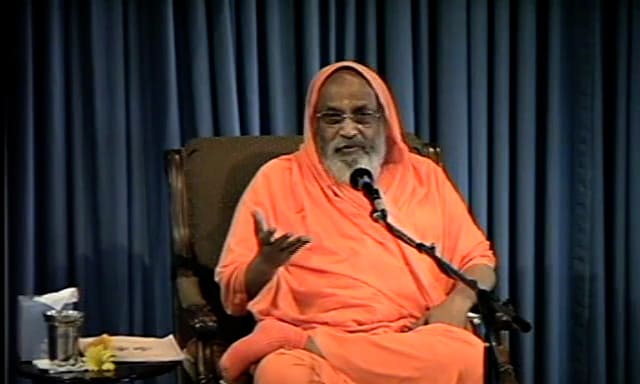
From talk on New Year’s Day message by Swami Dayananda Saraswati, Jan 1, 2006
Transcribed by Alan Kellogg and edited by Sharon Cliff.
This is the beginning of a new year. We can start afresh. Whether it is the first of January, the
fourteenth of April, or any other time, it is important. We need such an event. We require to
have a day or an event that we can call a beginning. The human being is always aspiring for a
better day, a better turn. He/she knows that what is here today may not be here tomorrow—lay
offs are always a possibility. If our situation is pleasant and comfortable, we want that situation
to continue. But if our situation is unpleasant or uncomfortable, we want a break. Let this new
year initiate a new turn, a new beginning. The hope is always there, but it has to be imbued with
some prayers.
Hope is on what basis? There is no basis for hope! Only the human heart is hopeful. There is
no other basis. What is the basis? Between the heartbeats “lub” and “dub,” there is a gap. “Lub.”
Then, if you are allowed, “dub.” You are alive now, so there is “lub.” To let the “dub” come and
then the “lub” come, there is grace. There is grace between the “lub” and the “dub.” There is
something that keeps us going, and that is what hope is all about. But then the basis for hope is
only prayerfulness. If we have a certain prayerful attitude, there is no reason why we can’t hope
for a better turn. We must aspire for it, pray for it, and work for it.
One important thing you must know: Even though we work for certain things that we want to
accomplish, there is no guarantee that we will accomplish them. It is clear that the effort we
make need not produce the result that we want. While watching a baseball game, the batsman
swings the bat at the ball and then looks out yonder for the ball. The catcher behind him has it.
There was no connection at all between the bat and the ball. If there is a connection and the ball
keeps traveling, it need not be a home run. It could be a foul ball. Then what is the use of that
connection? Or if it travels out to the field, a player out there may catch it. That player, in fact,
is prayerful that he will catch it. And the batsman is prayerful that he will not catch it. That is
why the Lord is sometimes confused. Therefore, the Lord occasionally obliges him and
occasionally obliges you. Now you can understand why we sometimes win and sometimes lose.
If we were always the winner, our competitor would always be the loser. And if the competitor
were always the loser, there would be no fun in competition. Where is the competition if one
loses all the time? Therefore, everything is okay. All is well.
Prayerfulness is a pervasive attitude, an attitude that governs our life, an attitude that gives us an
inner leisure whereby we can accommodate an unpleasant situation, if not pleasantly, we can at
least manage it. That inner leisure gives us the space that will enable us to face situations
objectively. And that space is provided by prayerfulness. Think of it. If we were not prayerful,
we would always think of ourselves as losers. But we are not losers because we are not the
authors of the results of action.
We are the authors of our actions only, not the authors of the results of our actions (karma
phalam)—the situations that we face. Given this fact, the most appropriate thing to do is to take
whatever result comes with an even attitude. By not getting what we want, we become wiser.
Not getting what we want does not mean we have become losers. We have a choice over our
actions—we can perform a given action, we need not perform it, or we can perform it
differently—but over the results of our actions, we have no choice whatsoever. The author of the
result of action is īśvara, the Lord. We can accept that.
We have a choice to make an effort to the best of our ability, banking upon our know-how, the
validity of our know-how, and the credibility of our know-how. Banking upon that alone we
perform action. However, that know-how may not be adequate. We have to take into account all
other factors, and many of those factors are unknown. We have no knowledge of the hidden
variables, and without knowledge of those hidden variables, how can we always be a winner?
We cannot always be a winner! To control the hidden variables, what can we do? We can do!
We can pray.
Prayer is an action. Prayerfulness is an attitude. We can pray for a better turn and for the
continuity of what we have that is good. But prayer is not enough. We also need to be
resourceful. We need to be active. We need to do. Every Hindu mother does this. She is
resourceful. She takes a bath in the morning and makes herself eligible for preparing food for
the family. Only she won’t say, “Food for the family and food for Īśvara, (naivedya).” She
prepares the food all right, for which she makes all the effort, and then the prepared food is
offered to Īśvara. Afterwards, the family eats the prasāda because Īśvara doesn’t take away what
is offered to Him. It is a great thing.
Suppose you offered one hundred and eight modakams to Ġaneśa and He stretched out His trunk
and took all one hundred and eight. You would be talking about it for three days. Then, suppose
you offered modakams again the next day and He took them away, and also the third day’s
offering He took away. Then you will ask for Ġaneśa ‘s help—”You please help. How can I
make one hundred and eight modakams every day?” But Ġaneśa doesn’t take it away. Do you
know why Ġaneśa doesn’t take away whatever you offer Him on the plate? Since Ġaneśa is over
here, over there, and everywhere—He is all pervasive (sarva vyāpī])—He wouldn’t know where
to keep it! So He leaves it there on the plate itself. He takes only your attitude (bhāvana).
Parokṣa priyāḥ sarve devaḥ . It is beautiful! We all understand this very well. Therefore, we
make an offering to the Lord, and then we take it back as prasāda.
We need to do. Doing is never discounted. We plan and we do. However, even if we plan and
do our homework properly, we can still miss out on what we want to achieve. There are a lot of
slips between the cup and the lips. Also there are a lot of slips between the plate and the mouth
and the mouth and the stomach. The food we eat may not go to the stomach; it may go into our
windpipe instead. People die because of that. They go to yama loka. This is not easy. When
that is so, we had better earn some of Bhagavān’s grace.
Prayerfulness is not enough. We need to be active. We need to be pragmatic. And prayer is part
of our pragmatism. What is pragmatism? When we objectively and dispassionately take into account all the factors and hidden variables that are there and then plan and do, that is pragmatism. What can we do to control the hidden variables? Pray! Prayer is an action. It is religious pragmatism. That is the vaidika. The vaidika is religiously pragmatic.
All of us assembling here in this hall before the Lord to begin this first day of the new year is
religious pragmatism. It is perfect! We could not begin it better. We begin with a prayer. On
New Year’s Eve many people get lost. But at least on the first day of the new year, we begin
with a prayer so that we won’t get lost. Prayer is an action, and it has a result. The result is
grace. We use the word “grace” for want of a better word. But, really speaking, the result of
prayer is grace. It is punya.
Punya alone accounts for what we call luck. And we earn that punya. We earn that luck. It is
not that luck is some chance. We pile up punya so that we will neutralize all the causes for bad
luck. The causes for bad luck are called durita. So durita kṣayārtham is the sankalpa the
priests will make before beginning the pūja —“To neutralize the causes that bring about
unpleasant situations and to enhance the causes that bring about pleasant situations, I perform
this ritual, this prayer.” So with the Lord’s/ Īśvara’s/ Dakṣināmūrti’s grace, may this new year,
2006, bring us what we want day after day and help us avoid what we don’t want. We need both.
We need to avoid what we don’t want; we need to achieve what we want; and what we have that
is good we need to retain (yoga kṣema). We pray for yoga kṣema.
Happy New Year to everybody! Happy New Year 2006!