


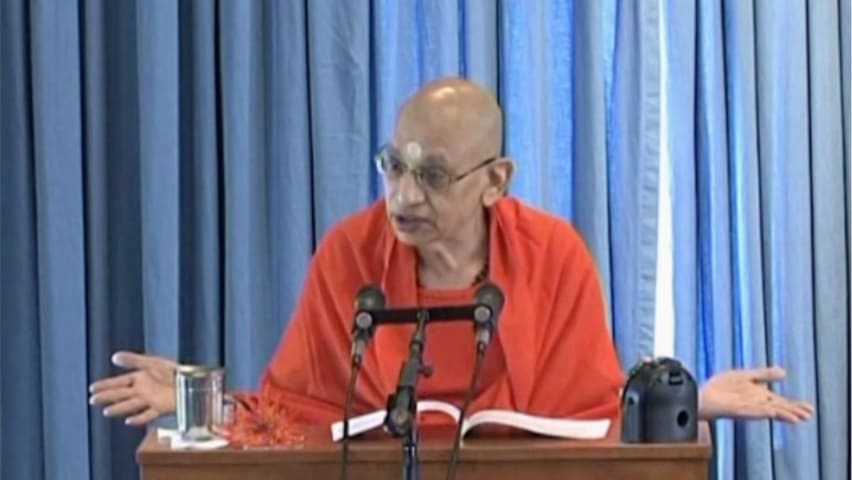
Satsang with Swami Viditatmananda Saraswati
Transcribed and edited by Anjali Bhat, Aparna Modi, Jayshree Ramakrishnan and KK Davey.
Question:
If God is within us, why should we go to the temples? Should we not pray to ourselves? Please explain the importance of worship at the temple. Are all the rituals necessary?
Answer :
When we worship Gaõeśa or Lakshmī or other deities, we are in fact, worshipping saccidānanda in a given a form. If you recite the hundred names of Gaõeśa or Lakshmī, any of these will refer to satyam jñānam anantam brahma. If God is manifest as the whole universe, then let all the actions performed be in the spirit of worship. To facilitate that worship, we have the temples. We have the same saccidānanda God who is given a form to which we can relate to. This is a very beautiful thing we have in our Vedic culture: that God is given a form, which enables us to establish a personal relationship with the Lord. That is how temples provide us an excellent opportunity to be able to directly worship God. Worshipping the Lord through everyday actions is easier said than done. When you interact with the world, rāga-dveśas or likes and dislikes are involved. Gaõeśa does not push these buttons. He does not mind anything. He is always predictable and always smiling. When you come to a temple, therefore, you feel safe and secure, and accepted easily because you can always relate to the Lord. Coming to temples and worshipping becomes an excellent training ground for our own feelings and our own hearts. Eventually you become mature enough to worship Gaõeśa as saccidānanda. Before that, you worships that same saccidānanda, but in a particular form with which you can relate. Therefore, the temples and the altars in our homes are very important, because they allow us to invoke the devotee from within us; that is the process of purification of our hearts, and we become more and more mature. So worshipping and participating in festivals is extremely useful; I should say extremely needed in invoking the devotee within us and making us mature, so that some day we stop making contracts with God and become less and less demanding and more and more offering. Then you will be ready to worship God beyond these forms.
******
Question :
Should prayer be performed in a specific or formal way?
Answer :
It is not necessary for prayer to be performed in a certain language or in a certain structured form. The point is if you want a specific result or outcome, a structure has been given and then you may have to perform a specific prayer in a specific way. If I desire the heavens, progeny, health, fame etc., then I should perform specific prayers that can bring about these specific ends. However, if your prayer is not meant for a specific outcome but for the purification of your mind or just for God’s grace, prayer can be informal also. It is the same in the matters of the world also. If I have a specific goal, then I must function in a specific way. If I want a specific dish, I have to prepare it in a specific way.
You can pray in an informal way in any language or in any form. You can also pray to any God. Specific rituals are prescribed to bring about a certain kind of outcome. But you do not have to do only those rituals to get those outcomes. It is not the only way. You can also keep repeating Lord’s name and ask for a certain result. It will work.
******
Question :
How is japa to be done?
Answer :
Doing japa is repeating the same name of the Lord in your mind. If it is done for a certain length of time, it becomes part of your being. At that stage it is called a japa, meaning that the name gets repeated in your mind, without any effort on your part. That is what happens, if japa is done in the depths of the mind. If you do it at a superficial level of your mind, then you need to put in effort to repeat that name. In course of time, if you are able to reach that depth of the mind where the japa takes place, it will keep on taking place without you having to do that.
How do we get to this stage? There is no other way than by doing japa and developing more and more concentration till that depth of the mind is reached. Thus it is by practice only that it can happen. Devotion is helpful in enabling me to acquire that tranquility of mind.
******
Question :
What is bhāva?
Answer :
Bhāva is devotion. In presence of God, the devotee is invoked in me, and this spirit of devotion which gets invoked is called bhāva.
******
Question :
How can one make progress in spirituality?
Answer :
One cannot become better spiritually, unless an attempt is made. There is a scheme in the creation, such that you will be given enough lessons in life and enough opportunities to learn from these lessons. The capacity to learn is given. Therefore the potential of recognizing the need for spiritual growth is there; and the means for the spiritual growth are also given. It is not that everyone will grow spiritually. But with the help of freewill one has to recognize it and initiate it.
******
Question :
How do you convince a non-believer of the journey within God?
Answer :
There is no question of not believing. Can you not believe in your own existence? God is the harmony, the order and the unity in life. We must understand this, not believe it. When we give thought to our life, we understand our purpose. As long as a non believer is a thinking person, he will understand it; unless he has decided not to believe
for some reason of his own. If the mind is open, the thinking person will understand this. If the whole universe is centered on this harmony and this universal principle, then why should my life be not centered on this? It is easy to make a person see this. It is right here and evident. If we are talking about a God in the heavens, then you need to be convinced; then it is a matter of faith. But the God we are talking about is not a matter of faith, and any open-minded person can understand it.
******
Question :
How do we know when we are getting into a commercial activity with God? How do we avoid trying to please God in order to get what we want?
Answer :
Our worship evolves, as Lord Krishna explains in the Bhagavad Gītā. In the beginning, a person remembers
God in distress; it’s all right—he still is a devotee. Later, the person approaches God where there is a need, when he wants something. It is like a contract or a business transaction. Then it evolves to the third level — the person wants to know God. Now the only agenda is knowledge, and you know God in His true nature. So in the beginning it is a commercial relationship, but it is all right. If you stretch your hand out seeking somebody’s favor, it may as well be for the favor of the Lord. The relationship will mature in the course of time and the person will be enlightened.
******
Question :
What is the Vedāntic view of apocalypse?
Answer :
In Hinduism, we have the concept of avatārās. The creator responds to situations when there is a difficulty. The universe was created such that it can run smoothly. When there are some digressions, avatārās are created to correct the problem.
******