


Based on Vedāntasāra lectures.
Transcribed and edited by Malini, KK Davey and Jayshree Ramakrishnan.
Every scripture and culture has ‘dos’ and ‘don’ts’. For instance, the Vedas ask us not drink alcohol, eat red meat, or hurt any being. Such prohibited or forbidden actions are called niṣiddha-karma. These acts are forbidden because they violate the order of life. They violate my own nature. When I perform forbidden or prohibited actions I violate the harmony in this world and, in so doing, I violate and hurt myself. These actions are forbidden because I do not want such actions to be done to me.
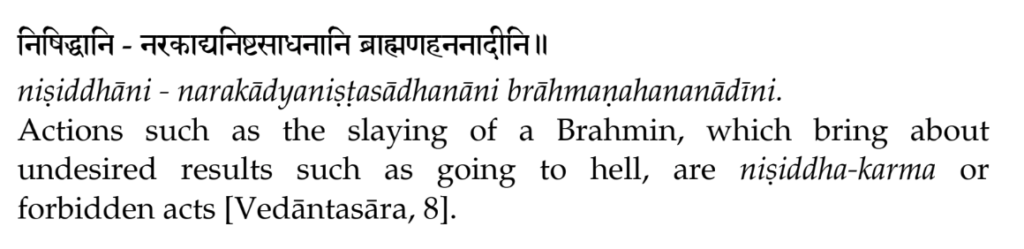
Narakādi aniṣṭasādhanāni. Aniṣṭasādhanāni are means to aniṣṭa, undesirable results. Since these actions bring about undesired or undesirable results, they should be avoided. What sort of results do they bring about? Narakādi, results such as hell. These prohibited actions give results not only in the hereafter, but in the present life as well. When I violate the order of life, naturally, there is duḥkha or pain and suffering both here and in the hereafter. Therefore, we can say that the suffering or pain we undergo now must be the result of some niṣiddha-karma we have performed in the past.
We are more likely to perform prohibited actions when impulses take hold of us
When do we do niṣiddha-karma? These actions are typically done only when we are not ourselves. When we are in our right minds, we do not perform such actions: we don’t insult, hurt, cheat, or lie to anybody. It is only when we are not in the right mind or when anger, passion, lust, greed, or similar impulses take hold of us that we are more likely to perform prohibited actions. We are told not to act out of anger, greed, or lust because our actions, when propelled by such impulses, are more likely to be undesirable or prohibited actions. Such actions will only bring undesirable results. They become the very obstacles in our path; therefore, we are advised to avoid niṣiddha-karma.
This passage gives a specific example of a forbidden action, brāhmaṇahananādīni, the slaying of a Brahmin. According to the Vedic tradition, the killing of a Brahmin or a cow is considered to be the worst kind of sin. A Brahmin is a learned person and represents the most evolved of human beings. In general, killing an evolved being is considered worse than killing a being that is less evolved, e.g., killing a mosquito. Therefore, we are advised to avoid killing a Brahmin or performing any actions that kill or hurt anybody.
We should deliberately avoid all actions, which violate the spiritual injunctions or accepted code of conduct. It is understood that when we violate others, we violate ourselves. When we hurt others, it is we who ultimately wind up getting hurt. Therefore, we are advised to give up al actions that violate the order1
.